
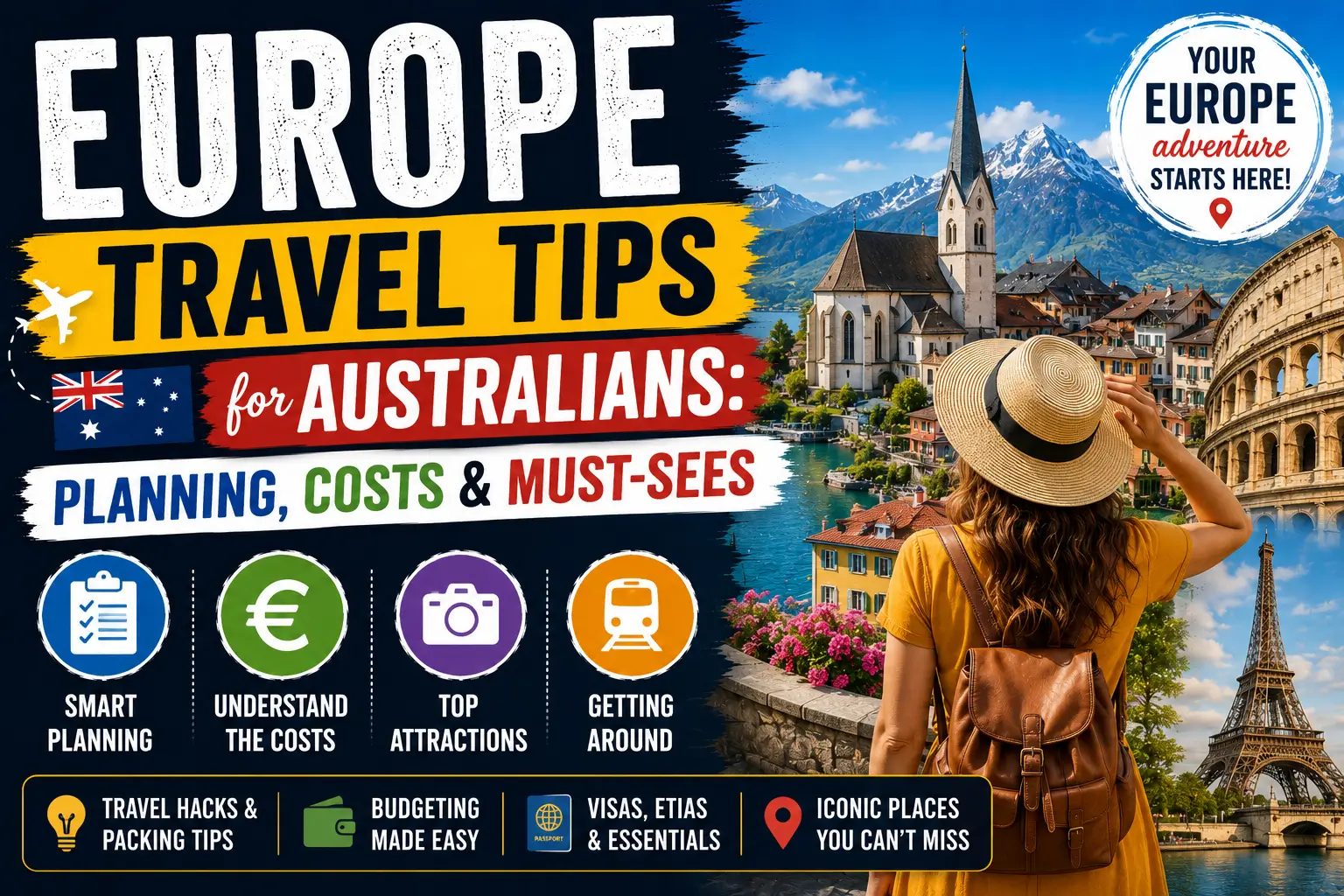

Europe is a bucket-list destination for most Australians — and for good reason. The continent packs 50 countries, thousands of years of history, and some of the world’s most extraordinary food, architecture, and landscapes into a space roughly the size of the continental United States. The challenge for Australians isn’t deciding whether to go; it’s deciding where to start and how to make the most of a long-haul investment. This guide covers the essentials for planning your first — or fifth — European adventure.
Understanding the Schengen Area and Visa Requirements
The Schengen Area is a bloc of 27 European countries where border controls between member states are largely abolished. Australian passport holders can travel within the Schengen Area visa-free for up to 90 days in any 180-day period. This covers the most popular destinations: France, Germany, Italy, Spain, Greece, the Netherlands, Portugal, and more. Non-Schengen countries including the United Kingdom, Croatia (partially), Ireland, and many Balkan states have their own entry arrangements.
From 2025, Australians require a European Travel Information and Authorisation System (ETIAS) pre-clearance for Schengen travel — an online application process costing roughly EUR 7, valid for three years. This is separate from a visa; think of it as a background check and travel approval. At the time of writing, the ETIAS launch timeline has been subject to delays — confirm the current status on the official ETIAS website before your trip.
Best European Cities for Australian First-Timers
Rome is the most visited city in Italy and one of the world’s great living history museums — the Colosseum, Vatican City, the Trevi Fountain, and Borghese Gallery are all within reach. Book the Vatican and Colosseum well in advance (months ahead during peak season) or join a skip-the-line tour. Paris needs little introduction: the Eiffel Tower and Louvre are obligatory, but it’s the city’s neighbourhood cafes, markets, and galleries that make it genuinely special.
Barcelona combines Antoni Gaudí’s surreal architecture (Sagrada Familia, Park Güell), world-class beaches, and a food scene centred on tapas and fresh seafood. Amsterdam offers canals, cycling culture, and exceptional museums including the Rijksmuseum and the Van Gogh Museum. Prague is one of Europe’s best-value capital cities — beautiful Gothic and Baroque architecture, low prices, and an authenticity that more touristy cities sometimes lack. For Australians who’ve done the ‘big five,’ Porto, Lisbon, Dubrovnik, Ghent, and Ljubljana are all excellent alternatives.
Getting Around Europe: Rail Passes and Budget Airlines
The Eurail Global Pass gives unlimited travel across 33 European countries for a set number of travel days within a defined period. For Australians doing multi-country trips, a Global Pass covering 15 travel days within two months suits most itineraries. Passes must be purchased outside Europe (including online before departure) and offer excellent value for active travellers. Book seat reservations on high-speed trains (TGV, Thalys, Eurostar) even with a pass, as these carry an additional reservation fee.
Budget airlines — Ryanair, easyJet, Wizz Air — offer extraordinary bargains between European cities, often under EUR 30 for a one-way fare. The catch: airports are sometimes 60 to 90 minutes from city centres, baggage fees add up fast, and schedules are not always convenient. Mix rail and budget air depending on the route. Flying London to Edinburgh or Barcelona to Lisbon is far slower than taking the train when you factor in airport transit time.
Structuring a Multi-Country European Itinerary
Most Australians visiting Europe for the first time have two to four weeks. A common mistake is booking too many countries — trying to see seven countries in 14 days leaves you feeling exhausted rather than enriched. A better approach: choose three to four countries with clear regional coherence. Western Europe classics (UK, France, Italy) or an Iberian focus (Spain, Portugal) or a Central European route (Germany, Czech Republic, Austria) make more coherent trips than criss-crossing the continent.
Enter and exit the same country if possible — booking a one-way flight into London and out of Rome (or vice versa) eliminates backtracking costs and opens up an efficient corridor through multiple destinations. Flying into Europe via the Middle East (Emirates, Etihad, Qatar Airways) is often cheaper from Australia than flying via Singapore or Hong Kong — compare all routings when booking.
Budgeting for a European Trip from Australia
Europe is not a budget destination, but it’s manageable with planning. Return flights from Brisbane or Sydney to Europe typically run AUD 1,800 to 2,500 in economy during off-peak periods, and AUD 3,000 to 4,500 in shoulder season. Accommodation in Western European capitals averages AUD 200 to 350 per night for a midrange hotel. Eastern and Southern Europe — Portugal, Czech Republic, Croatia, Poland — offer excellent value at AUD 100 to 180 per night for comparable quality.
A realistic daily budget (excluding flights) in Western Europe is AUD 300 to 450 per person covering accommodation, meals, transport, and admissions. In Eastern Europe that can drop to AUD 150 to 250. Travel in shoulder season (April to May or September to October) for the best combination of weather, value, and manageable crowd levels. Summer (June to August) is peak season — prices are highest, queues are longest, and the most popular sites book out months in advance.
Frequently Asked Questions: Europe Travel Tips for Australians
How long is the flight from Australia to Europe?
Brisbane to London or Rome via a Middle Eastern hub (Dubai, Abu Dhabi, Doha) takes approximately 22 to 26 hours including layover. Via Singapore the time is similar. Direct flights between Australia and Europe don’t currently exist — all routings involve at least one stop.
Do Australians need a visa to travel in Europe?
Australian passport holders travel visa-free in the Schengen Area for up to 90 days in any 180-day period. The ETIAS pre-clearance system (an online authorisation, not a visa) applies to Schengen entry from certain dates. Confirm the current ETIAS status before travel.
Is the Eurail Pass worth it for Australians?
For multi-country trips covering many rail journeys, yes. For a trip focused on one or two countries with point-to-point tickets, individual tickets often work out cheaper and are more flexible. A travel agent or rail specialist can run the numbers for your specific itinerary.
What currency is used across Europe?
The Euro is used in 20 of the 27 EU member states including France, Germany, Italy, Spain, Greece, and Portugal. The UK uses Pounds Sterling, Switzerland uses Swiss Francs, and several Eastern European countries retain their own currencies. Carry a small amount of local cash in each country; cards are widely accepted.
When is the best time to visit Europe from Australia?
April to June and September to October offer the best balance of weather, value, and manageability. July and August are peak season — very hot in Southern Europe, crowded everywhere, and expensive. For Christmas markets and winter scenery, November to December in Central Europe is magical.
Is it safe to travel solo in Europe as an Australian?
Generally yes. Western and Northern Europe are among the safest travel regions globally. Standard urban precautions apply — watch for pickpockets in tourist-heavy areas (Rome, Barcelona, Paris), use hotel safes, and register your travel plans on Smartraveller.gov.au.
Do I need travel insurance for Europe?
Yes, absolutely. European medical costs without insurance can be enormous. A good travel insurance policy covering medical emergencies, trip cancellation, and baggage loss is essential.
Europe rewards planning. The more thought you put into your itinerary before you fly, the more you’ll enjoy yourself once you arrive. Sai World Travel has helped hundreds of Australians plan European adventures — from first-timers seeing Paris for the first time to experienced travellers seeking off-the-beaten-track experiences. Get in touch to start planning.